Table of Contents
ToggleOverview
A candidate submitted a complete employment history through the Employee Verification Form, with all details appearing consistent during the initial review. As part of the standard background verification process, employment and identity checks were initiated to validate the information provided.
However, during deeper verification, inconsistencies began to emerge. The case required a careful, evidence-backed approach to confirm whether the submitted details matched independent verification records.
This case highlights how UAN employment history verification, alternate employment checks, document scrutiny, and Form 26AS validation helped identify discrepancies before onboarding.
The Challenge
At first, the candidate’s submitted details appeared credible. The employment information was complete, and the supporting document, including the payslip, looked genuine during the initial review.
However, when the declared employment history was cross-checked against independent verification sources, multiple concerns were identified.
Key challenges included:
- Employment details in the Employee Verification Form did not match records obtained through UAN-based checks
- The candidate continued to claim that the submitted information was accurate
- The payslip appeared credible at first glance, making the discrepancy harder to detect
- Further validation was required to confirm whether the issue was limited to one document or spread across multiple records
This made it important to go beyond surface-level document checks and verify the candidate’s details through multiple trusted data points.
Our Verification Approach
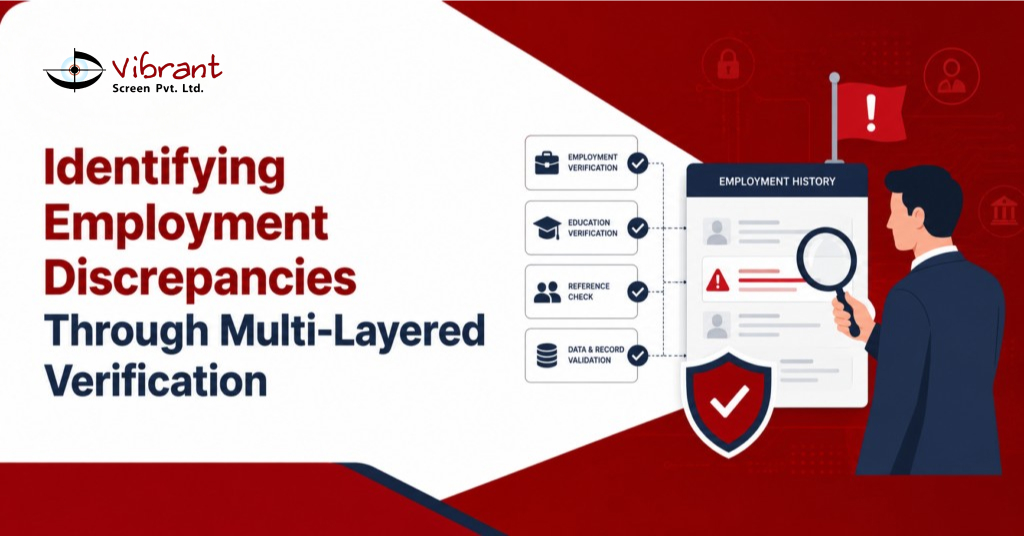
To ensure accuracy, the verification team followed a multi-layered background screening process. Instead of relying on a single source, the case was examined across employment, identity, financial, and document-level checks.
The process included:
1. UAN-Based Employment Check
The candidate’s declared employment history was compared with UAN-linked employment records. This helped identify mismatches between the information provided in the Employee Verification Form and the records available through independent verification.
2. Alternate Employment Verification
Since the initial findings showed inconsistency, alternate employment verification methods were initiated. This helped the team examine the candidate’s employment claims more deeply and reduce the risk of relying on incomplete or misleading information.
3. Document Scrutiny
The submitted payslip was reviewed in detail. While the name on the payslip matched the candidate’s name, further scrutiny revealed that the salary details and UAN number did not align with the verified records.
4. Form 26AS Verification
Form 26AS verification was also conducted to validate financial and identity linkage. During this step, it was found that the PAN submitted for verification belonged to another individual with the same name.
What Vibrant Screen Identified
Through structured investigation and quality checks, the team was able to identify clear inconsistencies across multiple records.
The key findings included:
- The employment history submitted by the candidate did not match UAN-based verification records
- The payslip was found to be tampered with
- The name on the payslip matched, but the salary details and UAN number differed
- The PAN submitted for Form 26AS verification belonged to another person with the same name
- Multiple data points confirmed that the declared information could not be treated as reliable
By consolidating evidence from UAN records, payslip review, PAN-linked information, and Form 26AS verification, the team established a clear discrepancy pattern.
Outcome
The candidate was flagged with a Red Report before onboarding.
This helped the organisation avoid potential hiring risks related to:
- Employment misrepresentation
- Document tampering
- Identity-linked inconsistencies
- Compliance exposure
- Reputational risk
The case was closed with documented evidence and quality-reviewed findings, giving the employer a clear basis for decision-making.
Key Learnings
This case shows why self-declared employment information should always be independently validated.
Important takeaways include:
- Documents that appear genuine may still require deeper verification
- UAN-linked records can help identify hidden employment history mismatches
- Form 26AS and PAN validation can reveal identity or financial linkage issues
- A multi-layered background verification process improves detection accuracy
- Trained verification teams and strong quality control are essential for reliable reporting
Conclusion
Employment background verification is not just about checking documents. It is about validating the accuracy of information across reliable sources.
In this case, a surface-level review may not have revealed the full risk. But by using a layered verification process, Vibrant Screen identified discrepancies across employment records, payslip details, UAN data, and PAN-linked information before the candidate was onboarded.
For organisations, this reinforces a simple but important point: thorough background verification can help prevent hiring risks before they become business risks.