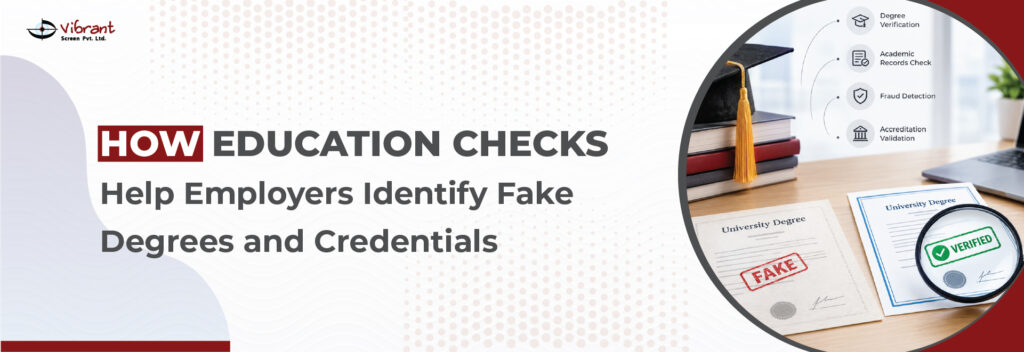
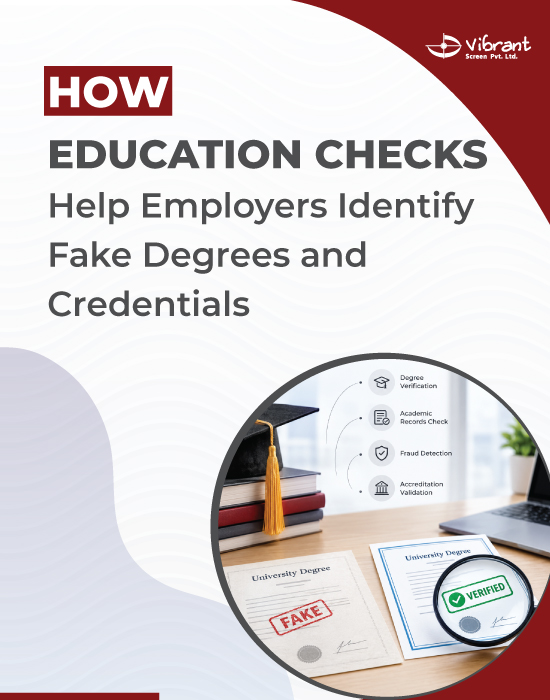
An education background check is an independent process that helps employers confirm a candidate’s academic qualifications directly with issuing institutions or authorised sources. In competitive job markets, candidates may present inaccurate or exaggerated details about their degrees, colleges, courses, or graduation years.
Relying solely on CVs and submitted certificates can create operational and compliance risks. Physical and digital certificates can be altered or fabricated, making them difficult to evaluate by visual inspection alone. Conducting formal education verification in India helps employers validate academic claims at the source, supporting hiring decisions based on verified information rather than unchecked documents.
Table of Contents
ToggleWhat Is an Education Background Check?
An education background check confirms a candidate’s academic history against records held by the awarding institution or an authorised repository, rather than against the documents the candidate supplies.
Key information verified during this process includes:
- Degree or qualification: The specific qualification awarded (e.g., Bachelor of Technology, Master of Business Administration).
- College, university, or board: The institution attended and, where relevant, its recognition, accreditation, or affiliation status.
- Course or specialisation: The major field of study, stream, or concentration.
- Year of graduation: The recorded year or date of completion.
- Enrolment details: Registration numbers and enrolment status, where available and applicable.
An education verification background check in India helps employers identify discrepancies in academic claims before making final hiring decisions.
How Education Checks Help Detect Fake Credentials
Academic screening uses direct checks with issuing institutions or authorised databases to review credentials across several common risk areas:
Identifying Fabricated Degrees and Certificates
Direct institutional checks can identify qualifications that the issuing institution cannot confirm. Comparing certificate details against official records can also reveal discrepancies that may indicate an altered or fraudulent document.
Checking the Authenticity of Educational Institutions
Verification can help establish whether an institution is recognised or appropriately authorised to award the qualification claimed. This can help employers identify credentials associated with unrecognised institutions or questionable degree providers.
Finding Qualification and Course Discrepancies
Institutional records often expose mismatched majors or qualification levels. For example, a candidate may claim a specialised degree on their CV, while available institutional records show a different course of study or a general qualification.
Confirming Attendance and Graduation Details
Education verification can confirm enrolment details, graduation dates, and qualification status where these records are accessible. It also helps identify cases where a candidate claims a completed degree, but the institution’s records do not show that the qualification was awarded.
How the Education Verification Process Works
An education background check typically follows a five-step workflow:
- Candidate Consent
Obtain the required candidate authorisation and consent before initiating verification, in accordance with applicable requirements. - Information Collection
Gather candidate-provided academic details, degree certificates, registration numbers, and mark sheets to provide the details needed to initiate verification. - Source Verification
Submit verification requests to relevant university offices, examination boards, or authorised digital verification portals, depending on the available verification route. - Credential Matching
Compare verified institutional records against the specific degree, course, dates, and marks submitted by the applicant. - Verification Report
Compile the verification outcome, including confirmed details, discrepancies, and any information that remains pending or could not be verified.
Why Education Verification Matters to Employers
Implementing structured academic screening offers several operational benefits for recruitment teams:
- Reduce the risk of CV fraud: Identify discrepancies in academic claims and reduce the risk of relying on inaccurate credentials.
- Support informed hiring: Base selection decisions on objective, source-verified qualifications.
- Meet role requirements: Confirm qualifications in positions where specific credentials are legally or operationally required.
- Mitigate post-onboarding risks: Identify credential discrepancies during pre-employment screening rather than discovering gaps after onboarding.
When Should Employers Conduct Education Checks?
Education checks can support general pre-employment screening and may be particularly important for roles where formal qualifications are central to the job requirements:
- Senior and managerial positions: Roles holding fiduciary, operational, or leadership responsibilities.
- Regulated finance functions: Positions where qualification standards form part of audit or regulatory expectations.
- Healthcare: Clinical and administrative roles requiring mandatory medical or technical credentials.
- Teaching and research posts: Academic roles requiring verified teaching degrees and subject qualifications.
- Technology and engineering: Positions recruited specifically for a named discipline or stream.
Building a More Reliable Hiring Process With Education Verification
Incorporating source-level verification into standard recruitment workflows gives HR teams a dependable framework for evaluating candidate credentials.
Vibrant Screen conducts education verification background checks in India as part of pre-employment screening. Combining technology-enabled verification workflows with expert validation, Vibrant Screen works to verify credentials through universities, colleges, and authorised repositories to deliver clear, structured reporting.
Education checks are commonly run alongside employment and identity verification, since discrepancies in one often prompt a closer look at the others. Talk to Vibrant Screen about integrating education verification in India into your hiring process.
Frequently Asked Questions
1. How can an education background check identify a fake degree?
An education background check verifies academic information through the issuing institution, authorised repositories, or other approved verification sources. If the institution has no record of the candidate’s enrolment or degree completion, the credential remains unverified and is flagged for employer review.
2. Can education verification detect altered or forged certificates?
Comparing submitted certificate details against official university registrar records can highlight inconsistencies in names, marks, or graduation years, indicating potential document tampering.
3. What happens if a candidate attended college but did not complete the degree?
Where records are available, verification can establish whether the degree was awarded or remains incomplete, identifying candidates who attended classes without graduating.
4. How are degrees from unrecognised or questionable institutions handled?
Verification checks the accreditation and legal recognition of the issuing body using authorised sources, flagging credentials issued by unaccredited or unrecognised institutions.
5. What if the specialisation mentioned on the CV is different from university records?
The verification report highlights discrepancies between candidate-submitted claims and official university records, noting the exact major or course of study recorded by the institution.
6. Can education verification confirm the exact year of graduation?
Where reliable records are available, official institutional archives can confirm the recorded passing year, roll number, and degree award date to match against the candidate’s claims.
7. What should employers do if a university does not respond to an education verification request?
When institutions delay or require manual processing, verification providers maintain the check in a pending status while pursuing alternative authorised verification channels or follow-up protocols.
8. Can education checks identify candidates who claim a higher qualification than they actually earned?
Education checks can identify discrepancies between a candidate’s claimed qualification and the qualification recorded by the issuing institution. For example, verification may reveal that a candidate claims a postgraduate degree when the available records confirm only an undergraduate qualification or diploma.